Blue Volkswagen Kombi
The Hanging GirlThe Blue Volkswagen Kombi becomes a central physical clue in the renewed investigation into Alberte Goldschmid’s death. Witnesses recall a light-blue van near the folk high school and among a small group that later disappeared; investigators connect those sightings to a photograph of an unidentified man and consider whether something attached to the vehicle’s unusual front fender could have caused Alberte’s body to be thrown into a tree. The van is never established by these recollections alone as the collision vehicle, but its partial identifications give the case a route from old local memories toward a specific suspect and his travels.
Identification and remembered details
Carl Mørck and Assad revisit the possibility of the Kombi after confronting a problem in the original search: a vehicle of that size should have been noticed leaving Bornholm by ferry. The surviving ferry-departure surveillance covered only the first two days after the incident, however. Carl proposes that the force which propelled Alberte into the tree might have been something removable and discarded, rather than a permanent part of the van. Assad raises the Kombi directly, and Carl points to its unusual fender: something, he reasons, may have rested on the front. This remains an investigative hypothesis, but it changes the question from whether the van itself was seen departing to whether a temporary attachment could explain the collision and then vanish.
A photograph of a man getting out of a Kombi is put before Kristoffer Dalby. He studies it through reading glasses, but says the image is too unclear for him to identify the man. His recollection of the vehicle is more definite: a van like it was often parked down the highway near the folk high school. He remembers it as light blue, with dark-tinted side windows, and says he never saw its front. The distinction matters. Dalby does not identify the photographed man, and his memory supports the presence of a similar vehicle rather than proving that the photographed Kombi was the one he saw.
Other recollections add detail while preserving that uncertainty. A witness who had seen the van from behind and at a distance describes matte windows, an old-fashioned black license plate with white numbers, and what may have been a curved black line rising from the roof. She also thinks the tires had a broad white streak around the hubcaps, but admits it might have belonged to another car. A separate account corroborates black plates and a curved line along the top of each side, while adding that there were no other noticeable marks, dents, or scratches. The repeated details make the vehicle more recognizable, but the witnesses’ qualifications prevent those features from becoming a perfectly reliable identification.
The collision hypothesis
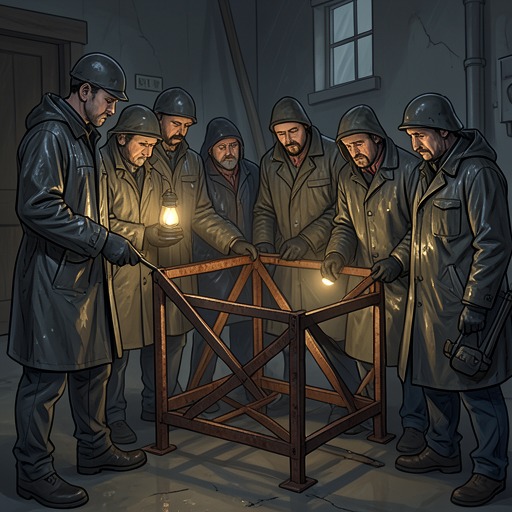
The Kombi’s investigative significance rests partly on its possible relation to the board associated with the collision. Carl tells Rose that he and Christian Habersaat share the suspicion that the board was attached to the front of the vehicle. To test whether that idea is physically plausible, he wants a photograph showing the board and the positions of its boreholes, which could be compared with the special fender. He also asks whether the presumed trajectories of Alberte’s body and bicycle, from the impact up into the canopy, have been diagrammed. These are proposed lines of inquiry, not conclusions: the vehicle, the board, and the mechanics of the collision still have to be connected by evidence.
That uncertainty explains why a removable object matters so much. If the Kombi had carried an attachment used in the impact, its absence from a later search would not disprove the vehicle’s involvement; the suspected component could have been detached and disposed of. Conversely, the remembered fender and the possible board do not by themselves establish that such an attachment existed. The van functions here as a testable physical arrangement: investigators seek photographs and measurements that might either make the theory coherent or undermine it, rather than treating resemblance as proof.
The people and places around the van
The recollections place a similar Kombi near a site occupied by about nine or ten young people, approximately four or five of each sex. They were described as peaceful, if eccentric, and one day they were simply gone. The person providing this account could not confirm when they left: the witness was frequently away and was in Groningen on a research trip at the relevant time, studying potato-flour manufacture. The group’s departure therefore offers context for the van’s local presence but does not fix its timing against the search for Alberte.
A further account identifies the van’s owner as someone apparently from Copenhagen, not Bornholm or Jutland. Rose’s report adds a motive for keeping it: the man regarded nature as sacred and healing, but did not think self-sacrifice required giving up his Kombi. He needed transport to reach places where people had worshipped the sun, elements, and supernatural phenomena. Over several years he travelled around Europe with a few followers, including to Gotland, Ireland, and Bornholm. On the island he sought out Bronze Age rock carvings, traces of ships in Troldeskoven, monoliths at Hjortebakken, and cult sites at Rispebjerg and Knarhøj; he was also interested in Knights Templar myths associated with Østerlars Church. This account gives the vehicle a purpose beyond mere transport: its mobility is integral to the man’s spiritual itinerary.
From background vehicle to narrative clue
The van’s identification advances through a chain of incomplete evidence: an unclear photograph, a remembered light-blue vehicle, recurring descriptions of dark or matte windows and black plates, and a possible curved marking. Each recollection narrows the field without closing it. Even the clearest-sounding details are qualified by limits of vantage and memory: Dalby never saw the front, another witness viewed the vehicle from a distance, and the white tire markings may belong to a different car. The investigation has to hold these fragments together without pretending they amount to certainty.
The Kombi also joins the mechanics of Alberte’s death to the wider search for the man behind it. Its unusual fender prompts the theory of a removable collision attachment; its appearances near the folk high school place it within a local social setting; and the owner’s repeated journeys explain why the vehicle mattered to someone drawn to sacred places across Europe. In that progression, it changes from an ordinary means of travel into an object under scrutiny. Its material features may help reconstruct an impact, while its capacity to move across borders and between sites makes it a route toward the still-unidentified driver.